

Exercise After 40 Needs a Broader Focus
For a long time, exercise was sold mainly through weight loss. If you wanted to lose weight or keep it off, the answer was usually more cardio: run, ride a bike, take a class, get on the elliptical, burn more calories. Strength training was something weightlifters did, and balance, mobility and flexibility were never even part of the story.
That focus has changed, and for good reason. Exercise after 40 has a bigger job than we were ever led to believe. It has to help you keep the strength to carry, climb, lift and get up from the floor; the balance to control your body when you step, turn or catch yourself; the mobility to move your joints through the ranges daily life requires; and the flexibility that allows muscles to lengthen as you move. In August 2026, the American College of Sports Medicine updated its model of physical fitness to include cardiorespiratory fitness, muscular fitness, flexibility and neuromotor fitness, which includes balance and gait speed, as interconnected components. (ACSM Components of Physical Fitness Roundtable)
Cardio Still Matters
The definition of cardio is sustained activity that raises your heart rate and breathing for a period of time. Brisk walking, running, cycling, swimming, rowing and many classes fall into this category. It trains your heart and lungs and helps maintain the endurance you need to walk through an airport, and climb stairs.
Strength Training
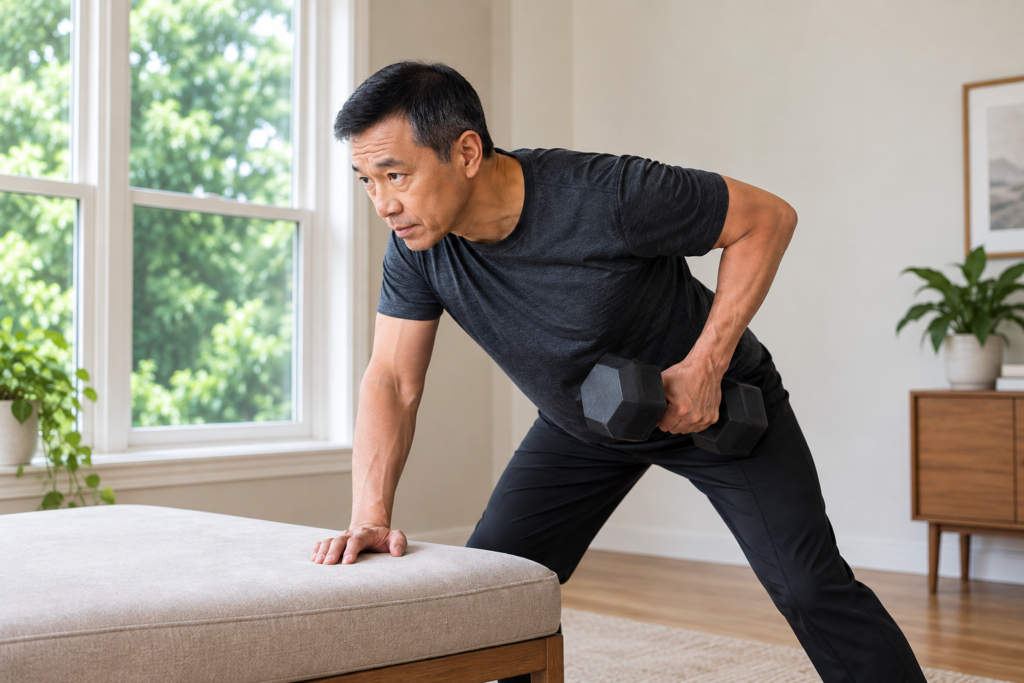
Strength training means making your muscles work against resistance. That resistance can come from dumbbells, barbells, machines, resistance bands, your own body weight or other forms of load. The purpose is to give your muscles a reason to build and get stronger so they can produce more force and continue handling the physical demands of daily life.
The 2026 American College of Sports Medicine position stand on resistance training pulled together 137 systematic reviews covering more than 30,000 people. It found that resistance training improves strength, muscle size, power and physical function in healthy adults. Those qualities show up in ordinary life every time you get out of a chair, carry luggage, lift something overhead, climb stairs, push, pull or catch yourself when something shifts unexpectedly. (ACSM Resistance Training Position Stand)
Strength training also matters beyond the muscle you can see. Resistance exercise helps build and maintain bone, and research in middle-aged and older adults has found that strength training can improve bone density. Strength training also helps with glucose (blood sugar) control. Research in adults with type 2 diabetes has found that strength training can improve A1C and fasting blood sugar. (Resistance Training and Bone Mineral Density Meta-Analysis) (Resistance Training and Glycemic Control Meta-Analysis)
Balance
Balance used to be something we talked about in older adults, but it’s something we should be working on much earlier so we can continue controlling our body when we’re standing still, moving, changing direction, or reacting to something unexpected. Standing on one leg is balance. So is stepping off a curb, walking on uneven ground, turning quickly, getting into a boat, moving through a crowded room or recovering when your foot lands somewhere you didn’t expect.
Balance deserves attention before it becomes an obvious problem. A large review of research in adults ages 40 to 60 found that regular physical activity improved both balance and strength. Later in life, exercise that includes balance work are specifically included in federal physical activity guidance for older adults because balance becomes increasingly important to fall prevention and physical function. Training balance in middle age gives you time to keep developing a quality you’ll rely on more as you get older. (Middle-Age Strength and Balance Meta-Analysis) (Physical Activity Guidelines for Older Adults)
Mobility
Mobility is how well your joints can move in the directions they’re designed to move. Good mobility makes it easier to bend, reach, turn, squat, step, and move without feeling stiff or restricted.
Think about how much movement you need from your hips to squat down, your ankles to walk down stairs, your shoulders to reach overhead, or your upper back to turn and look behind you. When those joints don’t move well, everyday movements can become harder and more uncomfortable. Working on mobility helps keep those joints moving so you can continue doing those things as you get older. (Hospital for Special Surgery)
Flexibility
Flexibility is the ability of a muscle to lengthen. Stretching is one of the most direct ways to improve it. When muscles such as your hamstrings, calves, hips, chest, or shoulders are very tight, they can make it harder to bend, reach, turn, or move comfortably.
A 2024 systematic review and meta-analysis that included 189 studies and more than 6,600 adults found that both single sessions and longer-term static stretching improved flexibility, and age did not significantly change the overall response. That means flexibility remains trainable as you age. (Static Stretching Flexibility Meta-Analysis)
How to Put It Together
You don’t need a separate workout for strength, cardio, balance, mobility, and flexibility. Some of these can be combined. The American College of Sports Medicine recommends including cardio, strength, flexibility, and exercises that improve balance and coordination as part of a complete exercise routine. So, a strength workout can include balance work, mobility and balance can often be done at the same time, and stretching can be done at the end of your workout. Cardio can be done separately through walking, cycling, swimming, or another activity you enjoy. (ACSM Exercise Position Stand)
After 40, a useful exercise routine will help you keep your heart, muscles, bones, balance, mobility, and flexibility healthy. These are what’s needed to climb stairs, sightsee, get off the floor, carry groceries, reach overhead, react to a misstep and continue moving the way you want as the decades pass.
To learn more about a place where we learn, discuss and put this into action, check out Living Rewired.